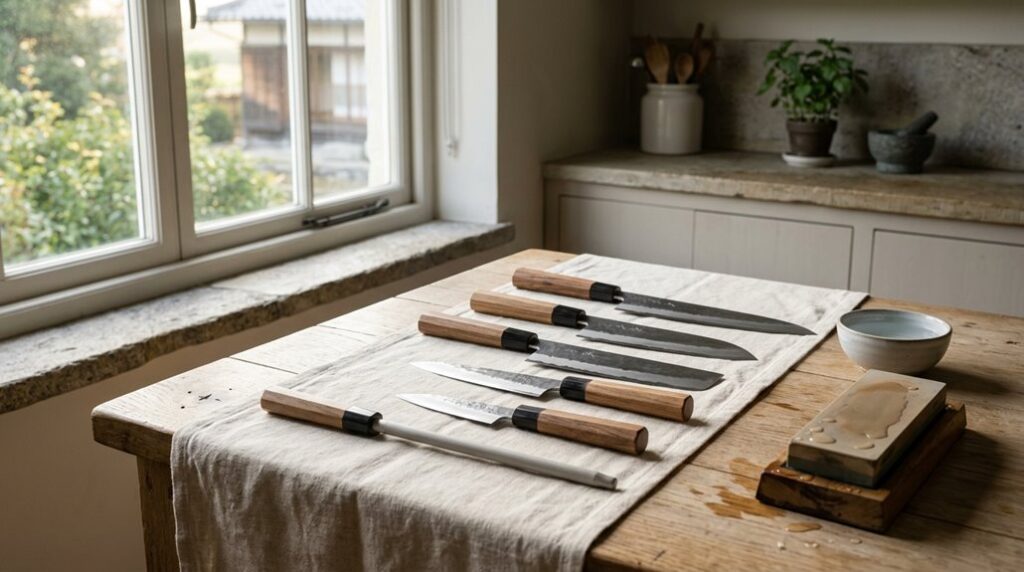
A sharp knife is the backbone of any kitchen, and choosing the right set can transform how you cook. I’ve found that the best Japanese knife sets for 2026 balance precision with practicality, offering you everything from full 16-piece collections to compact 5-piece essentials.
But here’s where it gets interesting: the real difference lies in which set matches your cooking style, storage space, and budget. Let me walk you through the options that stand out.
SHAN ZU 16 Piece Japanese Kitchen Knife Set with Block
If you’re looking for a thorough knife set that won’t leave you scrambling for the right blade, the SHAN ZU 16-piece collection delivers serious versatility. You get a chef knife, santoku, bread knife, carving knife, filleting knife, utility knife, fruit knife, six steak knives, sharpener, scissors, and block.
The forged high carbon steel blades feature a sharp 15-degree edge and laser-engraved patterns that look professional. Ergonomic pakkawood handles with triple-riveted construction feel balanced and secure. Hand washing keeps the steel in top shape. Everything slots neatly into the included block, protecting your blades and keeping your countertop organized.
Best For: Home cooks and professional kitchen users who need a comprehensive, versatile knife collection for various cutting tasks.
Pros:
- Comprehensive 16-piece set includes all essential knives plus sharpener, scissors, and storage block for complete kitchen readiness
- Forged high carbon steel blades with 15-degree edge deliver professional sharpness and performance
- Ergonomic pakkawood handles with triple-riveted full tang construction provide comfortable, balanced, and durable grip for extended use
Cons:
- High carbon steel requires hand washing and careful maintenance to prevent rust and corrosion, making it less convenient than stainless steel alternatives
- Not dishwasher safe, which limits cleaning flexibility and requires more deliberate care after each use
- Laser-engraved pattern, while attractive, lacks the premium aesthetic and prestige of authentic Damascus steel blades
Japanese Kitchen Knife Set of 5 (Wooden Box Case) Mr. Takaaki Nakamura
The KAKUSEE NK-8602 is your go-to set if you’re serious about Japanese knife craftsmanship without breaking the bank. This five-piece collection includes a sushi sashimi knife, vegetable nakiri, chef’s knife, petty knife, and small deba knife, covering nearly every cutting task you’ll encounter.
The forged stainless steel blades resist rust and clean up easily, while the wooden handles add authentic character. At 0.8 kg total weight with a 170 mm blade length standard, these knives feel substantial yet manageable. The wooden box case presentation makes it an attractive addition to any kitchen.
Best For: Home cooks and culinary enthusiasts who want a versatile, authentic Japanese knife set that delivers professional quality at an accessible price point.
Pros:
- Comprehensive five-piece set covers all major kitchen cutting tasks from delicate sushi preparation to vegetable chopping
- Forged stainless steel blades offer excellent rust resistance and easy maintenance without dishwasher requirements
- Presented in an attractive wooden box case suitable for display or gifting
Cons:
- Not dishwasher safe, requiring hand washing and careful maintenance to preserve blade quality and wooden handles
- Standard 170 mm blade length may not suit users who prefer longer or shorter knives for specific cutting styles
- Wooden handles require periodic care and conditioning to prevent drying and cracking over time
imarku Japanese High Carbon Stainless Steel Knife Set
Looking for professional-grade performance without the professional price tag? imarku’s 14-piece Japanese high-carbon stainless steel set delivers exactly that, and it’s designed with serious home cooks in mind, especially those setting up their first kitchen or upgrading from basic knife collections.
You’ll get chef, bread, slicing, Santoku, utility, and paring knives alongside serrated steak knives, kitchen shears, and a hardwood block with integrated sharpener. The precision-forged blades feature acute 10-15° edges that cut cleaner than typical European alternatives. Full-tang construction keeps everything balanced and reduces wrist strain. And because these knives resist rust and staining, you’ll spend less time maintaining them and more time cooking.
Best For: Serious home cooks and first-time kitchen setups seeking professional-grade performance at an accessible price point without compromising on quality or edge sharpness.
Pros:
- Acute 10-15° edges deliver cleaner cuts than typical 20° European blades, with built-in sharpener in the hardwood block for easy maintenance
- Full-tang construction and ergonomic design reduce wrist strain and provide balanced feel, making it accessible for users with arthritis or reduced hand strength
- High-carbon stainless steel resists rust and staining with minimal maintenance, and the comprehensive 14-piece set covers all essential kitchen tasks in one space-saving package
Cons:
- Hand-washing is recommended to preserve edge longevity, adding extra care steps despite being labeled dishwasher safe
- The acute 10-15° edge angle, while sharper, may require more frequent maintenance than traditional 20° edges for some users
- Pull-through sharpener built into the block may not provide the precision restoration that professional honing stones or services offer for long-term edge maintenance
SYOKAMI 7 Piece Japanese Style Kitchen Knife Set
You’ll want this set if you’re juggling kitchen duties while keeping safety a priority. The SYOKAMI 2026 upgrade features a foldable magnetic acacia wood block that stores in your drawer, keeping blades away from curious hands and paws. I appreciate the open-slot design because it lets you clean each knife thoroughly without wrestling with tight spaces.
The six knives (8″ chef, 7″ Santoku, 8″ slicing, 8″ bread, 6″ utility, and 3.8″ paring) cover virtually every cutting task. Hand-forged from high-carbon stainless steel at 56+ Rockwell hardness with precision 15-degree edges, they’ll deliver sharp, smooth cuts consistently. The ergonomic handles feature reserved finger positions for confident maneuvering, and you’re backed by a lifetime warranty.
Best For: Home cooks and families who prioritize both culinary performance and safety, especially those with children or pets who need secure knife storage.
Pros:
- Foldable magnetic storage design with open slots makes the set compact, safe, and easy to clean
- High-carbon stainless steel construction with 56+ Rockwell hardness and hand-forged 15-degree edges delivers professional-quality cutting performance
- Comprehensive 6-knife selection covers all common kitchen tasks, backed by a lifetime warranty and 100% satisfaction guarantee
Cons:
- Acacia wood block requires proper maintenance to prevent moisture damage despite its corrosion-resistant properties
- Foldable storage design, while convenient, may not appeal to those who prefer a traditional countertop knife block display
5-Piece Japanese Steel Kitchen Knife Set with Pakkawood Handle
Want professional-grade knives without the culinary school price tag? The SANMEIHO 5-piece set delivers serious performance with its high carbon steel construction and 63 HRC hardness rating.
You’re getting an 8-inch chef knife, 7-inch santoku, 7-inch fillet knife, 6-inch utility knife, and 3.75-inch paring knife, each hand-sharpened to a precise 12-degree angle. The pakkawood handles provide excellent grip and fatigue-free control during extended prep work.
And here’s what matters: these knives handle slicing, chopping, dicing, and mincing with minimal effort required. Heat-treated for edge stability and corrosion resistance, they maintain their razor-sharp edge longer than most competitors in this price range.
Best For: Home cooks and culinary enthusiasts who want professional-quality knives without premium price tags and need a versatile set for everyday kitchen tasks.
Pros:
- Exceptional edge retention and sharpness with 63 HRC hardness rating and precise 12° hand-sharpened angle requires minimal effort for slicing, chopping, and dicing
- Comprehensive 5-piece set covers all essential kitchen tasks with ergonomic pakkawood handles designed for balanced weight and reduced fatigue during extended use
- Professional-grade performance with heat-treated high carbon steel construction provides corrosion resistance and long-lasting durability
Cons:
- Requires hand washing only as knives are not dishwasher safe, adding to maintenance requirements and care responsibilities
- Pakkawood handles, while ergonomic and attractive, may not appeal to traditionalists who prefer full tang metal or wood handles
- Set lacks a storage solution like a knife block or magnetic strip, requiring separate purchase for safe storage and kitchen organization
Factors to Consider When Choosing a Japanese Kitchen Knives Set
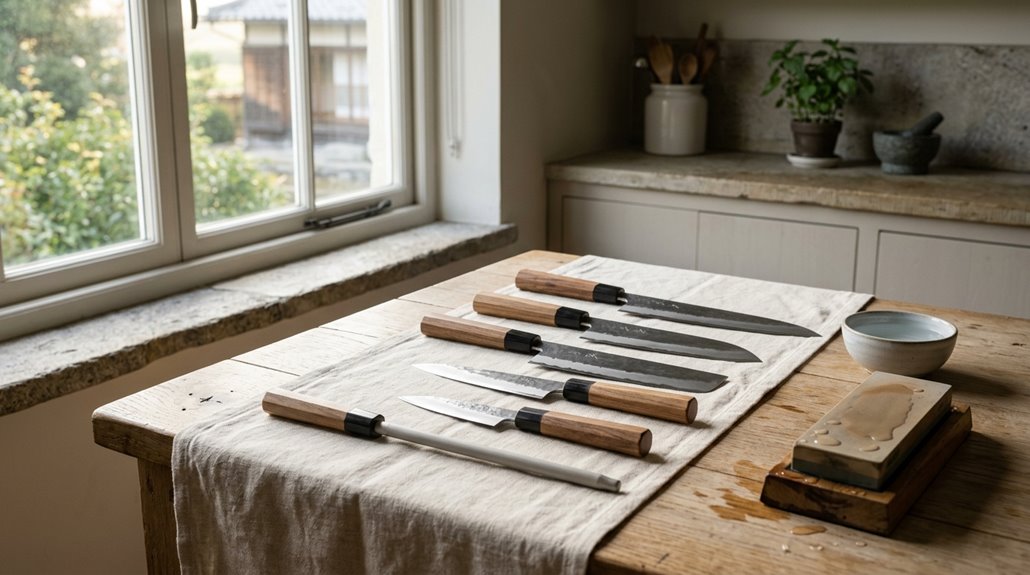
Before you invest in a Japanese knife set, I want to help you zero in on what actually matters for your cooking style and kitchen needs. You’ll want to consider several key factors: blade material and construction (which determines durability and edge retention), handle comfort and ergonomics (because you’re holding this thing for hours), edge angle and sharpness (affecting both performance and maintenance), maintenance and care requirements (the realistic upkeep you’re willing to do), and set composition and versatility (whether you’re getting tools you’ll actually use). Let’s break down each of these so you can make a choice that fits your hands, your habits, and your kitchen.
Blade Material And Construction
The material and construction of a Japanese knife’s blade determine how well it’ll perform in your kitchen and how much maintenance it demands. I’d recommend looking at high-carbon stainless steel and forged stainless steel options, which balance edge retention, corrosion resistance, and upkeep nicely. Forged blades generally offer better durability and balance than stamped alternatives, giving you smoother cuts and longer-lasting performance.
You’ll also notice Japanese blades feature edge angles between 10–15 degrees per side, delivering a noticeably sharper profile compared to typical Western knives. And here’s the trade-off: high-carbon content improves sharpness but requires careful maintenance to prevent rust and staining. Pair this with full-tang construction and quality handles like Pakkawood or wood, which enhance control and stability during use.
Handle Comfort And Ergonomics
A knife that feels awkward in your hand will exhaust you faster than a dull blade, so I’d prioritize comfort and ergonomics as seriously as you would sharpness. Look for ergonomic handles designed with non-slip surfaces and contoured grips that reduce wrist strain during extended prep work. Many quality sets feature full-tang construction with triple-riveted handles, which distributes weight evenly and gives you better control.
Materials matter too: Pakkawood and wood handles offer both secure grip and visual appeal. And here’s what I find essential: moisture resistance. When your hands are wet or oily, anti-slip features keep you safe and confident. If you’ve got reduced hand strength or arthritis, seek lightweight, balanced designs that won’t leave your hands aching after dinner prep.
Edge Angle And Sharpness
Why does edge angle matter so much when you’re comparing Japanese knife sets? The angle at which your blade’s edge is ground directly determines how sharp it’ll cut and how long that sharpness lasts. Japanese knives typically feature angles between 10-15 degrees per side, compared to the standard 20-degree European approach. That narrower angle gives you a keener, finer cut, though you’ll need regular maintenance to prevent chipping.
High-carbon stainless steels pair well with these acute angles, balancing edge retention with corrosion resistance. Look for sets advertising built-in edge angles or pull-through sharpeners designed to maintain that 10-15 degree edge during regular use. The sharper your blade’s angle, the more demanding the upkeep, but the payoff in cutting performance is genuinely worth considering for your cooking style.
Maintenance And Care Requirements
Honestly, maintaining your Japanese knife set is where the real commitment kicks in, and it’s non-negotiable if you want those gorgeous 10-15 degree edges to keep performing. Hand washing and thorough drying are essential, since most sets specify non-dishwasher use and moisture sensitivity. Store your knives in a designated block, magnetic strip, or protective sheath to protect blades and extend longevity. Avoid loose storage that dulls edges quickly.
Regularly sharpen with included sharpeners or professional honing to maintain optimal performance. Follow manufacturer guidance on maintenance frequency, noting that some sets include built-in sharpeners or reinforced blocks to reduce re-sharpening needs. Dry knives after washing before storage, preventing water exposure that causes staining or rust on high-carbon stainless steels.
Set Composition And Versatility
When you’re shopping for a Japanese knife set, the number of pieces included matters far more than you might initially think, and it directly shapes what you can actually accomplish in your kitchen. A 5-piece set keeps things minimal with essentials like chef’s and paring knives, while sets stretching to 16 pieces introduce specialized blades: santoku, sashimi, deba, and bread knives. More pieces mean greater versatility across cuisines and prep techniques.
Consider your cooking style before committing. Do you need filleting precision for seafood? A bread knife for crusty loaves? Full-tang construction in larger sets typically ensures superior balance and durability.
Beyond blade variety, storage solutions like wooden boxes or magnetic blocks protect your investment and keep knives organized and accessible.