
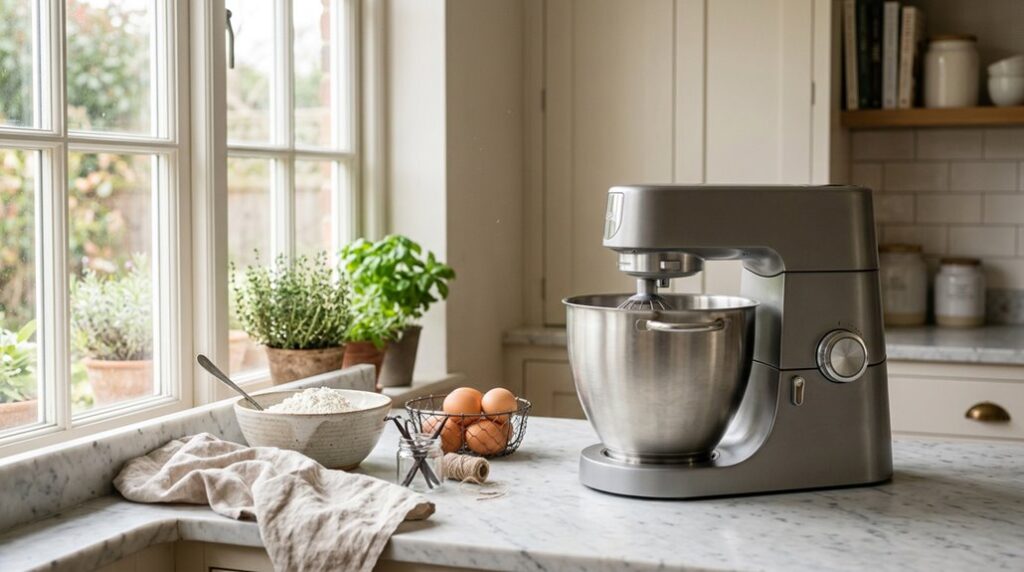
Like Goldilocks searching for that perfect bowl, I’m here to help you find a kitchen mixer that’s just right for your needs. You’ve got options ranging from compact 3.2-quart models to hefty 5.5-quart powerhouses, and honestly, the right choice depends on what you’re actually making.
Whether you’re a casual baker or someone who tackles dough weekly, there’s a mixer designed with your workflow in mind. Let me walk you through the top contenders and what actually matters when you’re deciding.
KitchenAid Classic Series 4.5 Quart Tilt-Head Stand Mixer K45SS, Onyx Black
Want a stand mixer that handles everything from delicate whipped cream to heavy bread dough without requiring you to hover over it? The KitchenAid Classic Series K45SS does exactly that. Its tilt-head design lets you access the bowl easily, while the locked head keeps things stable during mixing.
You get a 4.5-quart stainless steel bowl, three standard attachments (flat beater, dough hook, and wire whip), and 10 speed settings. The 59 touchpoints ensure thorough, consistent mixing across batches. At 275 watts and 22 pounds, it’s built sturdy without being unwieldy. The power hub accepts optional attachments for expanded capability. Plus, most components are dishwasher safe, making cleanup straightforward.
Best For: Home bakers and cooks who want a reliable, versatile stand mixer that can handle everything from delicate whipping tasks to heavy dough kneading without requiring constant supervision.
Pros:
- Tilt-head design provides easy bowl access while the locking mechanism keeps the mixer stable during operation
- 10 speed settings and 59 touchpoints deliver thorough, consistent mixing for a wide variety of recipes and techniques
- Power hub accepts optional attachments (food grinders, pasta makers, and more) for expanded functionality beyond the included three attachments
Cons:
- 4.5-quart capacity may be limiting for very large batches or commercial-scale baking projects
- 275-watt motor is less powerful than some higher-end stand mixer models, which may affect performance with very dense doughs
- 1-year limited warranty is relatively short compared to some competitor offerings in the stand mixer category
Kitchen in the Box Stand Mixer 3.2Qt
Looking for a stand mixer that won’t monopolize your counter space? I’d recommend checking out this compact option. At under 7 pounds with dimensions of 12.9″ x 7″ x 10.2″, it’s genuinely portable for everyday baking tasks.
You get six speed settings that handle everything from delicate meringues to sturdy bread dough, plus a 3.2-quart stainless steel bowl with a transparent anti-splash lid. The tilt-head design makes loading ingredients and swapping attachments straightforward. Four anti-slip suckers keep it stable during operation, and the aluminum dough hook, flat beater, and stainless steel whisk are all included. Its 300-watt motor delivers reliable performance without demanding premium kitchen real estate.
Best For: Home bakers and cooks who need a reliable, space-saving stand mixer for everyday mixing tasks without sacrificing performance or counter space.
Pros:
- Compact and lightweight (under 7 lbs) with a portable design that fits easily on most countertops
- Versatile 6-speed motor handles a wide range of mixing tasks from delicate meringues to thick bread dough
- Includes all essential attachments (whisk, dough hook, flat beater) and features a convenient tilt-head design for easy bowl and accessory swapping
Cons:
- 3.2-quart capacity may be limiting for large batch recipes or family-sized portions
- 300-watt motor, while reliable, has lower power compared to premium stand mixers for heavy-duty kneading
Cuisinart Stand Mixer 5.5-Quart 12 Speeds (SM-50BCNAS)
The Cuisinart SM-50BCNAS delivers serious mixing power for home bakers and cooks tackling varied prep tasks. Its 500-watt motor runs through 12 speeds, giving you precise control whether you’re whipping cream or kneading dough. The 5.5-quart stainless steel bowl accommodates substantial batches, and the tilt-back head design makes bowl access effortless.
You’ll appreciate the included chef’s whisk, flat paddle, and dough hook, plus the splash guard with pour spout keeps your countertop cleaner. But here’s where it gets versatile: optional attachments like pasta extruders, meat grinders, and ice cream makers transform this into a multi-function kitchen workhorse. The die-cast metal construction feels sturdy, and at 17 pounds, it anchors itself during operation without requiring bolting down.
Best For: Home bakers and cooks who need a versatile, powerful stand mixer capable of handling everything from delicate whipping tasks to heavy dough kneading with the flexibility to expand functionality through optional attachments.
Pros:
- 500-watt motor with 12 speeds delivers precise control and powerful performance for varied mixing tasks, from whipping cream to kneading dough
- 5.5-quart stainless steel bowl with tilt-back head design accommodates large batches and provides easy access for filling and cleaning
- Highly versatile with optional attachments (pasta extruder, meat grinder, ice cream maker, spiralizer) that transform it into a multi-function kitchen workhorse
Cons:
- Optional attachments are sold separately
- Limited to one power outlet for attachments, meaning you can only use one optional attachment at a time
- At 17 pounds, it’s relatively heavy and may take up considerable countertop space, though this weight does provide stability during operation
Hamilton Beach Electric Stand Mixer 4 Quarts White
If you’re juggling budget constraints with baking ambitions, this Hamilton Beach stand mixer deserves your attention. Its 300-watt motor handles thick batters and doughs without breaking a sweat, while the planetary mixing action ensures complete bowl coverage.
You’ll appreciate the seven speeds plus that slow first setting, which reduces splatter when you’re getting started. The stainless steel bowl holds four quarts, and everything from the bowl to attachments washes up in your dishwasher. With a dough hook, flat beater, and whisk included, you’re ready for cupcakes, cookies, bread, and more.
The built-in handle makes moving this six-kilogram workhorse simple, and Hamilton Beach backs it with a one-year warranty.
Best For: Budget-conscious home bakers who need a reliable stand mixer capable of handling various dough and batter recipes without sacrificing quality or durability.
Pros:
- 300-watt motor with planetary mixing action delivers thorough, hands-free mixing for thick batters and doughs
- Complete dishwasher-safe components (bowl and all attachments) make cleanup quick and convenient
- Seven speeds with a slow first setting reduce splatter while providing versatility for cupcakes, cookies, bread, and other baked goods
Cons:
- 300-watt motor may have less power compared to premium stand mixers for handling very heavy or professional-volume batches
- One-year warranty is relatively short compared to some competitor brands
- At approximately 6 kilograms, it’s heavier than some portable mixers, which could be inconvenient for frequent relocation or limited counter space
Hamilton Beach 6-Speed Electric Hand Mixer White
For home bakers who want reliable power without the counter clutter, this hand mixer delivers. The 250-watt motor powers through six speeds plus QuickBurst when you need extra oomph for thick batters. You get two traditional beaters and a whisk, all dishwasher safe for quick cleanup.
I appreciate the built-in bowl rest that stabilizes the mixer at your bowl’s edge, cutting down on messy drips. The lightweight, compact design stores easily, and that snap-on case keeps attachments organized and prevents loss. At just 1.3 kg with a five-foot cord, it’s genuinely portable. The one-year warranty backs your purchase, making this a solid choice for occasional to moderate baking needs.
Best For: Home bakers and casual cooks who need a portable, reliable hand mixer for occasional to moderate baking without taking up valuable counter or cabinet space.
Pros:
- Powerful 250-watt motor with 6 speeds plus QuickBurst function handles thick batters and various mixing tasks
- Lightweight and compact design (1.3 kg) with snap-on storage case keeps attachments organized and makes the mixer easy to store or transport
- Built-in bowl rest reduces drips and mess while stabilizing the mixer, and all attachments are dishwasher safe for convenient cleanup
Cons:
- Hand mixer design requires active holding during use, which can cause fatigue during extended mixing sessions compared to stand mixers
- Limited to the included beaters and whisk attachments with no option for additional specialty attachments
- 250-watt motor may struggle with very heavy doughs or large batch quantities that a stand mixer would handle more efficiently
Factors to Consider When Choosing a Kitchen Mixer
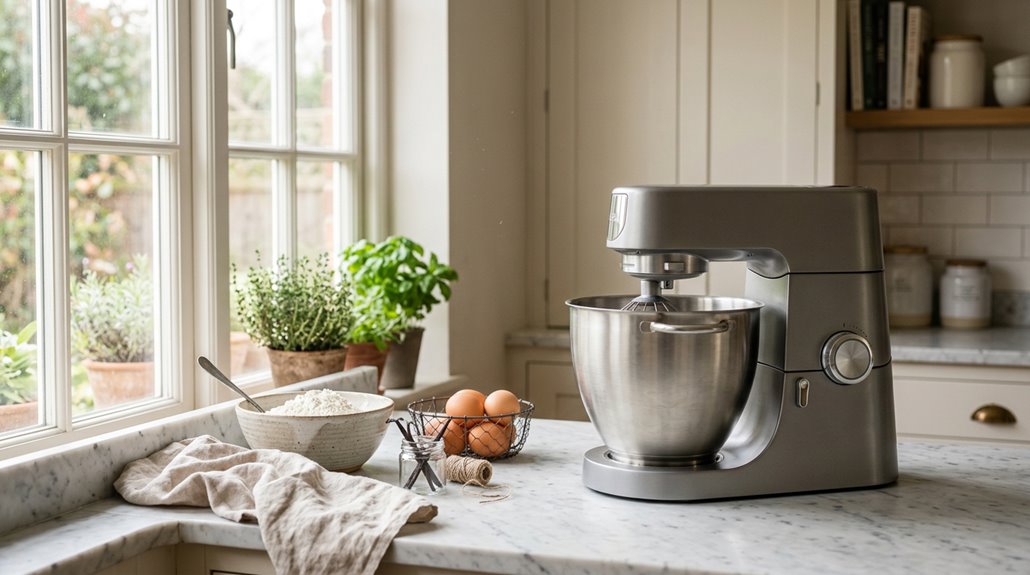
Before you invest in your next mixer, I want to help you focus on what actually matters: capacity and bowl size that fits your cooking style, motor power and speed options that handle everything from delicate meringues to dense doughs, mixing action quality that ensures even blending without dead zones, attachment versatility so you’re not limited to one task, and design plus portability features that work with your kitchen setup. Here are the key factors I’d evaluate:
- Capacity and Bowl Size: Think about your typical batch sizes—do you bake for a family of four or whip up restaurant-style quantities? Larger bowls (5-6 quarts) handle bigger jobs, while compact models (3-4 quarts) save counter space.
- Motor Power and Speed: Higher wattage motors (400+ watts) and multiple speed settings give you control and reliability, especially when you’re working with thick batters.
- Mixing Action Quality: You’ll want thorough, consistent blending without unmixed pockets at the bottom, which separates quality mixers from mediocre ones.
- Attachment Versatility Options: Beyond standard beaters, consider whips for whipping cream, dough hooks for kneading, and paddle attachments for general mixing.
- Design and Portability: Ask yourself whether you’ll leave it on the counter or store it away, and whether a lightweight hand mixer suits you better than a stationary stand model.
Capacity And Bowl Size
One of the most practical decisions you’ll make when selecting a kitchen mixer comes down to bowl capacity, which directly impacts how much you can prepare in a single batch. Common sizes range from 3.2 Qt to 5.5 Qt, and choosing the right one depends on your typical recipes.
A larger bowl, like 4.5 Qt or 5.5 Qt, lets you handle bigger doughs or multiple dozen cookies without batching. You’ll appreciate the efficiency when tackling ambitious projects.
Most quality mixers feature stainless steel bowls for durability and easy cleanup, and tilt-head designs give you convenient access when adding ingredients. Match your bowl size to recipes you frequently prepare. This prevents overfilling, ensures even mixing, and saves you time and frustration.
Motor Power And Speed
How much muscle does your mixer really need? I’d say it depends on what you’re actually making. Most reliable kitchen mixers pack 300 to 500 watts, which handles everything from delicate whipped cream to dense bread dough without breaking a sweat. More speeds (think 6, 12, or beyond) give you finer control, letting you adjust for different textures and ingredients throughout your mixing process.
But here’s the thing: wattage alone doesn’t tell the whole story. A powerful motor that maintains consistent performance across speeds matters more than raw numbers. Bowl size, gear design, and planetary mixing action all work together to determine how effectively that power translates into real performance.
Choose a mixer that matches both your typical tasks and your kitchen ambitions.
Mixing Action Quality
The way your mixer actually contacts the ingredients matters far more than you might think. I’m talking about the difference between mediocre results and consistently excellent ones. It all comes down to how the machine moves.
Look for planetary mixing action, where the beater travels around the bowl while rotating, ensuring uniform blending across every speed. A tilt-head design gives you close access for thorough ingredient incorporation. And those 59 touchpoints on models like the KitchenAid K45SS create multiple contact zones for genuinely even mixing.
Don’t overlook attachment variety either. Multiple options like flat beaters, dough hooks, and whisks let you tailor your mixing action to what you’re making, whether that’s dense doughs, delicate batters, or fluffy whipped creams. Higher-speed settings amplify these benefits, enabling rapid whipping and better volume development for specific recipes.
Attachment Versatility Options
What separates a one-trick mixer from a kitchen workhorse? Attachment versatility. I’ve found that most stand mixers ship with three core attachments: a flat beater for general mixing, a dough hook for kneading, and a wire whisk for whipping. But here’s where things get interesting.
Many models feature a power hub that accepts optional attachments like pasta makers, food grinders, and spiralizers, dramatically expanding what you can accomplish. Some brands build entire accessory ecosystems around specific models, with color-matched options that feel intentional and organized. And dishwasher-safe components? They’re absolute game-changers for cleanup after tackling diverse tasks.
When evaluating mixers, check whether that power hub exists and which attachments are available. It’s the difference between owning a mixer and owning a complete kitchen system.
Design And Portability
After you’ve figured out which attachments matter most to you, design and portability become your next critical considerations, especially if you’re working with limited counter space or need to tuck your mixer away between uses. Look for tilt-head designs that give you easy access to the bowl and simplify both installation and cleaning. Compact footprints and lightweight builds make a real difference in smaller kitchens, offering better storage efficiency and portability.
Built-in handles or ergonomic grips help you lift and maneuver the mixer safely. Anti-slip bases or suction discs keep things stable while you’re blending or mixing. Transparent splash guards with clear lids minimize mess while letting you monitor your progress without stopping mid-blend.
Durability And Materials
How long will your mixer actually last? I’d look closely at the materials and construction. A sturdy metal or die-cast metal body forms the foundation for durable, long-lasting performance and stable operation during heavy mixing sessions.
The bowl and attachments matter too. Stainless steel resists staining, corrosion, and withstands frequent dishwashing without degrading. Check that beaters, hooks, and whips are dishwasher-safe and corrosion-resistant for repeated use.
Robust construction counts significantly. The head and chassis should feature reinforced joints that prevent flex during high-speed mixing, ensuring the machine stays solid under stress.
And here’s a practical indicator: solid warranties (several years or more) reveal manufacturer confidence in durability. That warranty isn’t just paperwork; it’s a promise backing the build quality.
Warranty And Support
When you’re dropping serious cash on a kitchen mixer, the warranty backing it up matters just as much as the motor inside. I’d recommend checking what coverage you’re actually getting, since warranties range from one year to three years depending on the model. Most warranties protect you against defects in materials and workmanship, which covers manufacturing hiccups but not user damage.
Here’s what I focus on:
- Keep your proof of purchase handy, as you’ll need it for claims
- Verify customer support availability and accessibility
- Consider how warranty length affects long-term value
And don’t overlook after-sales support channels. A brand that stands behind its product with responsive help makes ownership less stressful when problems arise.